What Does a Beautiful Room Actually Cost?
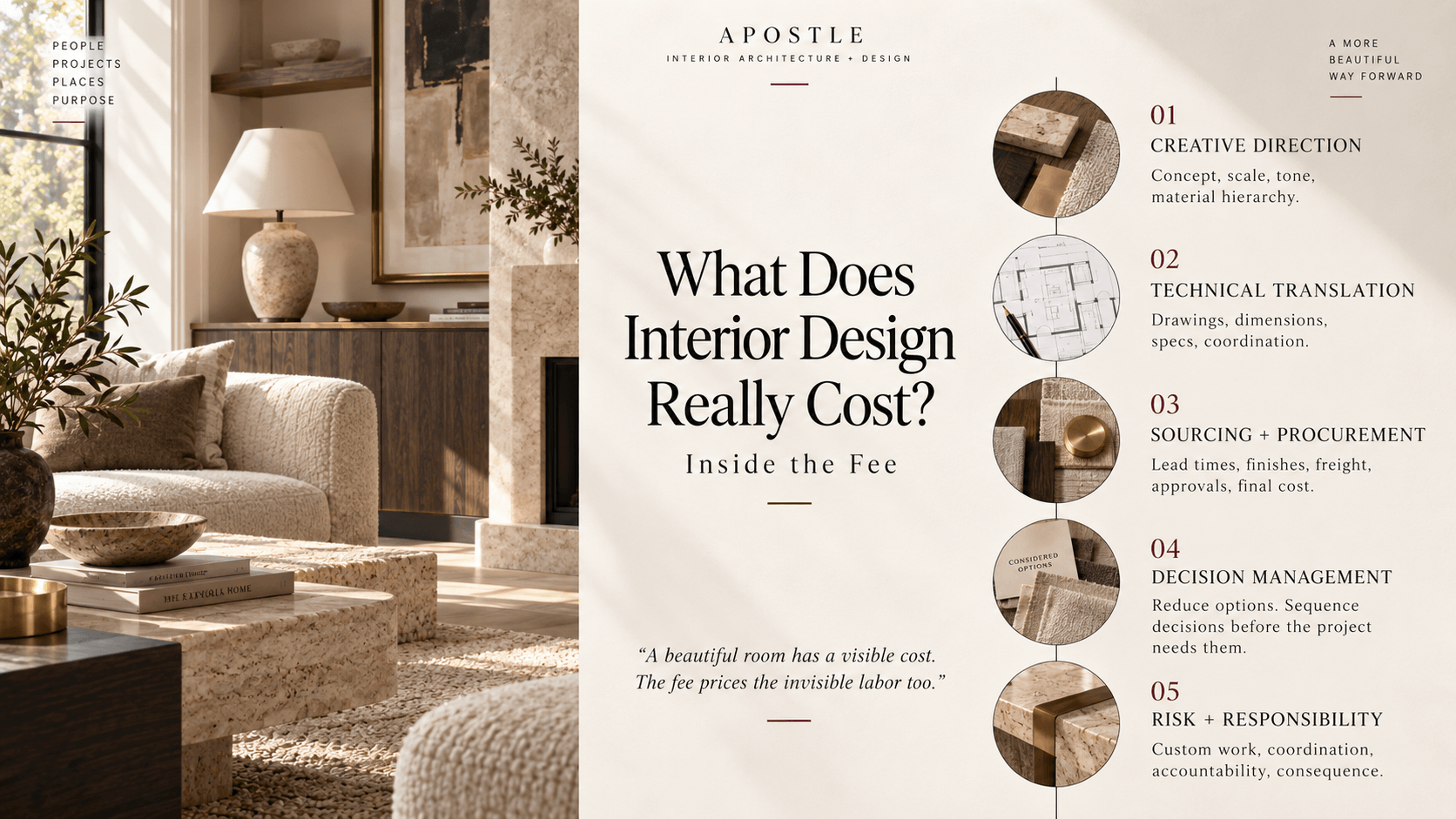
THE OBJECTS ARE THE EASY PART
A client can point to a sofa, a light fixture, or a slab of stone and understand that it has a price. The harder number is the one attached to design labor because the most valuable work often disappears into the result.
A well-resolved room contains hundreds of decisions that no longer look like decisions. The outlet is where it needs to be. The drapery clears the millwork. The table arrives after the floor is protected. The stone edge matches the drawing. The contractor is building from the latest information. The client is not re-deciding the same thing three times.
That coherence is labor.
CREATIVE DIRECTION
Concept development is not the act of collecting attractive images. It is the work of defining the room’s governing idea strongly enough that later decisions can be judged against it. Scale, tone, material hierarchy, circulation, focal points and the balance between restraint and emphasis all begin here.
TECHNICAL TRANSLATION
A design becomes buildable through drawings, dimensions, specifications and coordination. This is where a beautiful thought is forced to answer practical questions: how high, how deep, what substrate, which edge, which junction, which switch, which clearance.
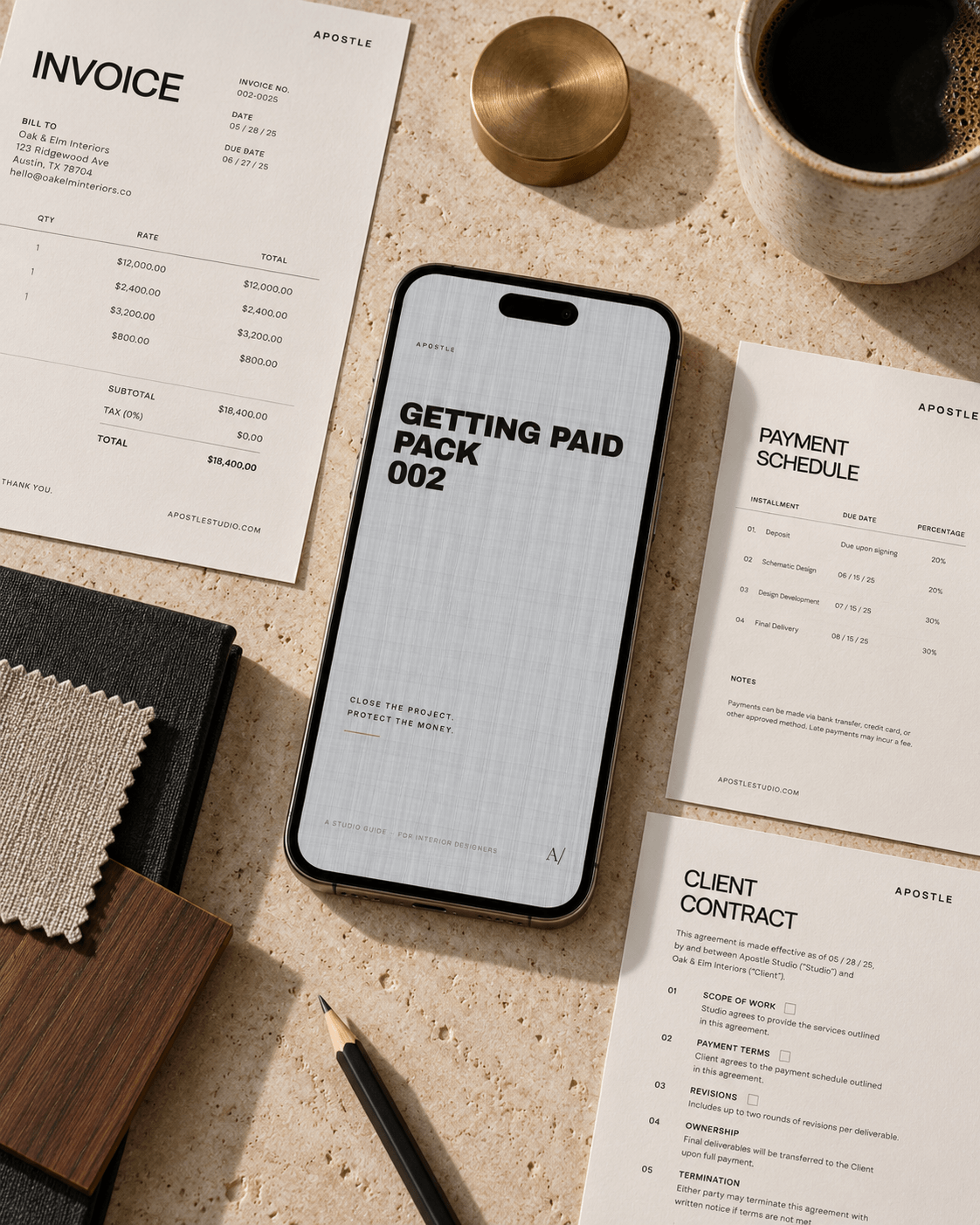
Getting Paid Pack: Close the project. Protect the money. The proposal, payment schedule, change order, and contract checklist every interior designer needs to get paid on time — in your brand, ready in an afternoon.
WHAT’S INSIDE
Four documents carry a project from yes to paid — plus the guide that ties them together.
The Proposal & Fee Agreement — wins the yes and sets the terms.
The Payment Schedule — maps deposits and milestones so money arrives on time.
The Change-Order Form — captures every scope change so it’s approved and paid for.
The Contract Checklist — the terms your agreement must cover, in plain English.
Each in Canva, Word, and a fillable PDF — plus a branded how-to guide.
HOW IT WORKS
Make it yours. Add your logo, colors, and terms once — about twenty minutes.
Send with confidence. Proposal to sign, schedule to map the money, invoices at each milestone.
Get paid, protected. Scope stays honest, payments stay on time, and the awkward money talk disappears.
WHY IT’S DIFFERENT
Not a generic contract dump. A considered, on-brand system in the Apostle design language — the same restraint you bring to a room, brought to your business. Built for the studio just starting out, priced for it too.
WHO IT’S FOR
New and growing interior designers — residential or commercial — who do beautiful work and want the business behind it to feel just as intentional.
FREQUENTLY ASKED
Do I need design software? No. Edit in Canva, or Word / Google Docs or Adobe Express. Clients get a simple fillable PDF.
Can I use my own branding? Yes — swap the logo, colors, and fonts, and it’s your studio.
Is this legal advice? No — these are professional business templates and a starting point, not a legal document. Have a qualified attorney review your paperwork for your state.
Residential or commercial? Both. Scope, fee, and terms flex to either.
What format do I get? Canva, Word, and fillable PDF versions, plus a branded guide.
How do I receive it? Instantly — a download link on the confirmation page and by email.
Will it work outside the US? The structure travels; set the terms and tax language to your country and review locally.
I already have a contract — is this useful? Yes. Use the checklist to audit it, and the rest to round out your system.
Is there anything more advanced? Yes — this pack credits toward the full Workshop.
What’s your refund policy? Because it’s an instant digital download, all sales are final.
LEGAL FOOTER / DISCLAIMER
The Getting Paid Pack 002 provides professional business templates for general information only. It is not a legal document and does not constitute legal advice or create an attorney–client relationship. Laws vary by jurisdiction; consult a qualified attorney before using any document with clients. © 2026 Apostle Interior Architecture and Design.
TERMS OF USE
Apostle IAD grants each purchaser of the Getting Paid Pack 002 a single-user license. This means the template may be used internally by you and your team within your own design studio but may not be shared outside your business.
This license applies to the Getting Paid Pack 002 purchased on www.apostleiad.com, as well as any supplemental materials or bonus content included with your download.
Your purchase includes:
Unlimited internal use across projects within your studio
Permission to duplicate the template for multiple client projects
The ability to customize the content to suit your workflow
Your purchase does not include:
Reselling, leasing, or licensing the template or any version of it to others
Sharing or distributing the editable template with external contractors, clients, peers, or third parties
Uploading the template to any public forum, educational resource, or marketplace
Using the template for commercial gain outside your own studio operations
This license is non-exclusive, meaning the product is available for purchase and use by other interior designers and studios.
NON-REFUNDABLE PURCHASE
Due to the digital nature of this product and its immediate delivery upon purchase, all sales of the Getting Paid Pack 002 are final and non-refundable. Once the file has been delivered, we are unable to offer refunds, exchanges, or cancellations.
Please review all product details before purchasing, and reach out to our team with any questions prior to checkout. By completing your purchase, you acknowledge and agree to these terms.
SOURCING AND PROCUREMENT
Finding an object is only one step. Confirming lead time, finish, availability, freight, receiving, damage risk, COM requirements, substitutions, approvals, and final cost is the work around the object. Procurement is a logistics function disguised by beautiful things.
DECISION MANAGEMENT
Every project has a cognitive budget. Too many options, late approvals, or unresolved alternates consume it quickly. Designers are paid partly to reduce the number of decisions the client has to make—and to sequence the remaining decisions in the order the project can actually use them.
RISK AND RESPONSIBILITY
Fees also carry responsibility. The more custom the project, the more coordination is required and the greater the consequence of a missed assumption. A custom wall is not priced like a retail bookcase because it asks the design team to solve a different category of problem.
THE PRACTICE
When pricing your own work, stop asking only, “How long will the drawings take?” Map the entire service: thinking, documenting, communicating, revising, coordinating, procuring, tracking, and closing. A beautiful room has a visible cost. A sustainable studio has to price the invisible one too.
Xo,