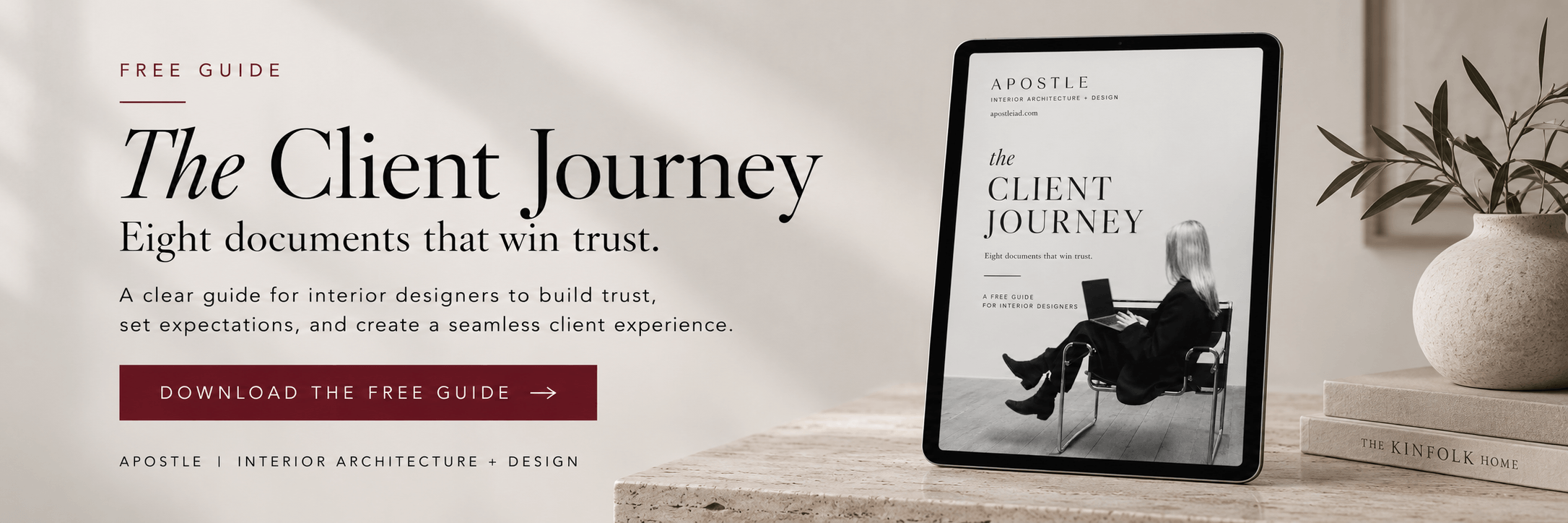
Eight Documents That Make a New Studio Feel Established

Clients read professionalism long before installation day. They read it in the way you ask, explain, confirm, present and close.
THE CLIENT SEES THE SYSTEM BEFORE THE ROOM
A client may hire you because of a room. They decide whether they trust you because of everything that happens before the room exists.
That is where documents become part of the design service. Not legal clutter. Not “admin.” They are the interfaces through which a client understands what is happening, what is expected, what something costs and what comes next.
A small studio can feel deeply established when those interfaces are clear.
ENQUIRY & DISCOVERY FORM
Before a call, collect the basics that determine fit: project type, location, timeline, investment range, decision-makers and what the client is hoping to change. A useful enquiry form saves both sides from a discovery call that should never have been booked.
SERVICES & INVESTMENT GUIDE
Explain how you work before asking someone to buy it. This is where service categories, typical investment ranges, process and boundaries become visible. The goal is not to answer every question. It is to make the right questions easier to ask.
PROPOSAL & FEE AGREEMENT
The proposal turns interest into a defined engagement. Scope, phases, deliverables, fee, exclusions and assumptions should be legible enough that both sides understand the same project.
WELCOME GUIDE
Once the agreement is signed, the emotional state changes. Excitement is mixed with uncertainty. A welcome guide answers the immediate operational questions: how communication works, what happens next, how meetings happen, what the client needs to provide and how decisions will be handled.
CLIENT QUESTIONNAIRE
A useful questionnaire goes beyond style labels. Ask about routines, friction, storage, hosting, privacy, maintenance, sensory preferences and what a good day in the space looks like. The purpose is not to gather adjectives. It is to understand use.
DESIGN PRESENTATION
A presentation is not a folder of options. It is a decision environment. Show one curated direction, explain the reasoning, name the decisions required and make approvals visible.
FF&E & BUDGET TRACKER
Projected, quoted, approved and actual. Those four states make money legible. A client who can see the status of an item and the budget around it is far less likely to feel that the project is drifting.
HANDOVER & CARE GUIDE
The project should not disappear after installation. Finish schedules, care instructions, warranties, key sources and remaining contacts belong in a closeout package that signals completion rather than abandonment.
THE PRACTICE
Do not build all eight at once. Start with the next missing threshold in your current client journey. If enquiries are chaotic, start there. If clients sign and then flood your inbox, build the welcome guide. If money becomes unclear during procurement, build the tracker.
Professionalism is often just uncertainty removed in advance.
Download the free Client Journey Guide after taking the Studio Health Quiz. It maps all eight documents in order.