Your Hourly Rate Is Not Your Price

Clients are not purchasing units of your time. They are purchasing a defined result delivered through your judgment.
A rate is one input. A fee is a business decision. Confusing the two is how talented studios stay busy and still wonder where the money went.THREE NUMBERS, NOT ONE
Most new studios talk about “the hourly rate” as though it is the single number that determines whether a project makes money. It is not. There are at least three numbers to understand: what an hour costs your business, what you charge for an hour, and what the project must earn as a whole.
Those numbers can be related without being identical. That distinction matters because design is full of invisible time: proposals, sourcing, vendor follow-up, revisions, bookkeeping, travel, emails and the half-hour spent reconstructing a decision because no one documented it.
KNOW YOUR COST BEFORE YOUR RATE
Your internal hourly cost begins with compensation, but it cannot end there. Add the expenses required to keep the studio operating: software, insurance, accounting, marketing, equipment, education, professional fees and the unbillable hours necessary to run the business.
If the business needs 1,000 genuinely billable hours from you in a year, dividing annual needs by 2,080 fantasy hours will make the math look better than the business feels. Price from the hours you can actually sell.
“A billable rate must cover cost and leave room for profit. ”
A BILLABLE RATE HAS TO CARRY THE STUDIO
A billable rate must cover cost and leave room for profit. That does not mean multiplying a number by an arbitrary industry factor. It means understanding what the rate is being asked to carry.
A useful test is to reverse the math: if you billed this rate for the realistic number of hours available, would the resulting revenue cover overhead, your pay, taxes and the profit you want the business to retain? If not, the rate is not sustainable simply because it feels marketable.
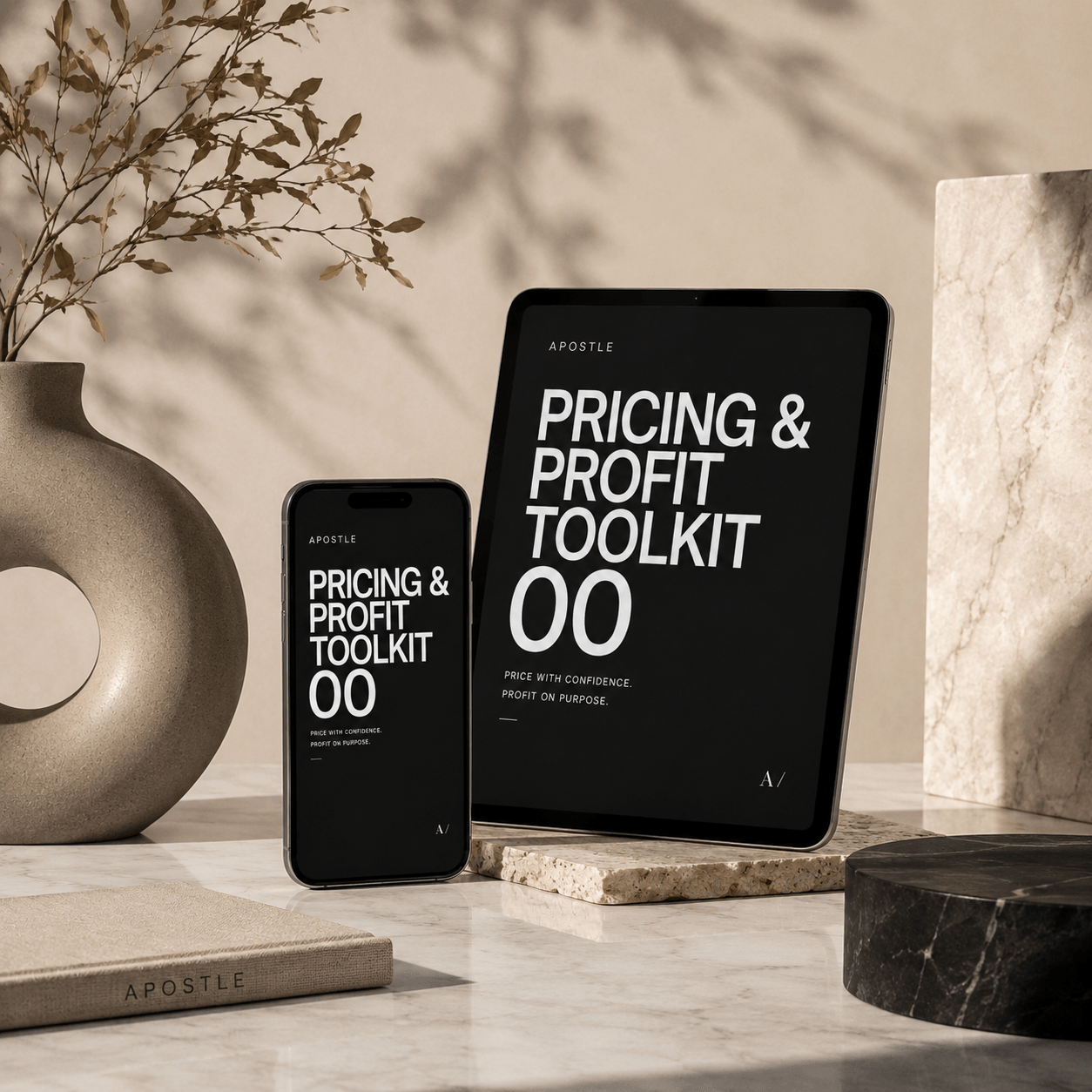
Pricing and Profit Toolkit: Know what to charge — and whether you're making money.
About this product: Price your work like you know its worth. Stop guessing your rate, leaving profit in your sourcing, and finishing projects unsure they paid. A simple spreadsheet that tells interior designers their true hourly rate, the profit in their sourcing, and whether each project actually paid. Fill in the blue cells; the rest calculates itself.
WHAT’S INSIDE
Four tabs. Every number you've been guessing at.
Hourly Rate Finder — your true rate, after tax, overhead, and honest billable hours.
Markup & Procurement Fee — price one item or a whole schedule; see the profit instantly.
Project Profitability — after each project, your real profit and real hourly rate.
Start Here — a one-page map to get you going.
HOW IT WORKS
Type only into the oxblood (red) cells. Black cells calculate for you.
Start with the Rate Finder — it sets the number the other tabs use.
Return to it before every proposal and after every project.
WHAT YOU GET
Four-tab spreadsheet (Excel & Google Sheets)
Pre-built formulas — nothing to set up
Worked examples in every tab
A short, designed how-to guide
Yours to keep and reuse
FAQ
Good with spreadsheets? You don't need to be. Type a number in a highlighted cell — that's it.
Excel or Google Sheets? Both, formulas intact.
Is it accounting software? No. It's a pricing and profit tool for the decisions you make daily; it sits alongside your bookkeeping.
Will it set my market price? It sets your floor — the rate that meets your income goals. Price up from there.
TERMS OF USE
Apostle IAD grants each purchaser of the Pricing and Profit Toolkit 00 a single-user license. This means the template may be used internally by you and your team within your own design studio but may not be shared outside your business.
This license applies to the Pricing and Profit Toolkit 00 purchased on www.apostleiad.com, as well as any supplemental materials or bonus content included with your download.
Your purchase includes:
Unlimited internal use across projects within your studio
Permission to duplicate the template for multiple client projects
The ability to customize the content to suit your workflow
Your purchase does not include:
Reselling, leasing, or licensing the template or any version of it to others
Sharing or distributing the editable template with external contractors, clients, peers, or third parties
Uploading the template to any public forum, educational resource, or marketplace
Using the template for commercial gain outside your own studio operations
This license is non-exclusive, meaning the product is available for purchase and use by other interior designers and studios.
NON-REFUNDABLE PURCHASE
Due to the digital nature of this product and its immediate delivery upon purchase, all sales of the Pricing and Profit Toolkit 00 are final and non-refundable. Once the file has been delivered, we are unable to offer refunds, exchanges, or cancellations.
Please review all product details before purchasing, and reach out to our team with any questions prior to checkout. By completing your purchase, you acknowledge and agree to these terms.
THE PROJECT FEE IS ABOUT SCOPE AND RISK
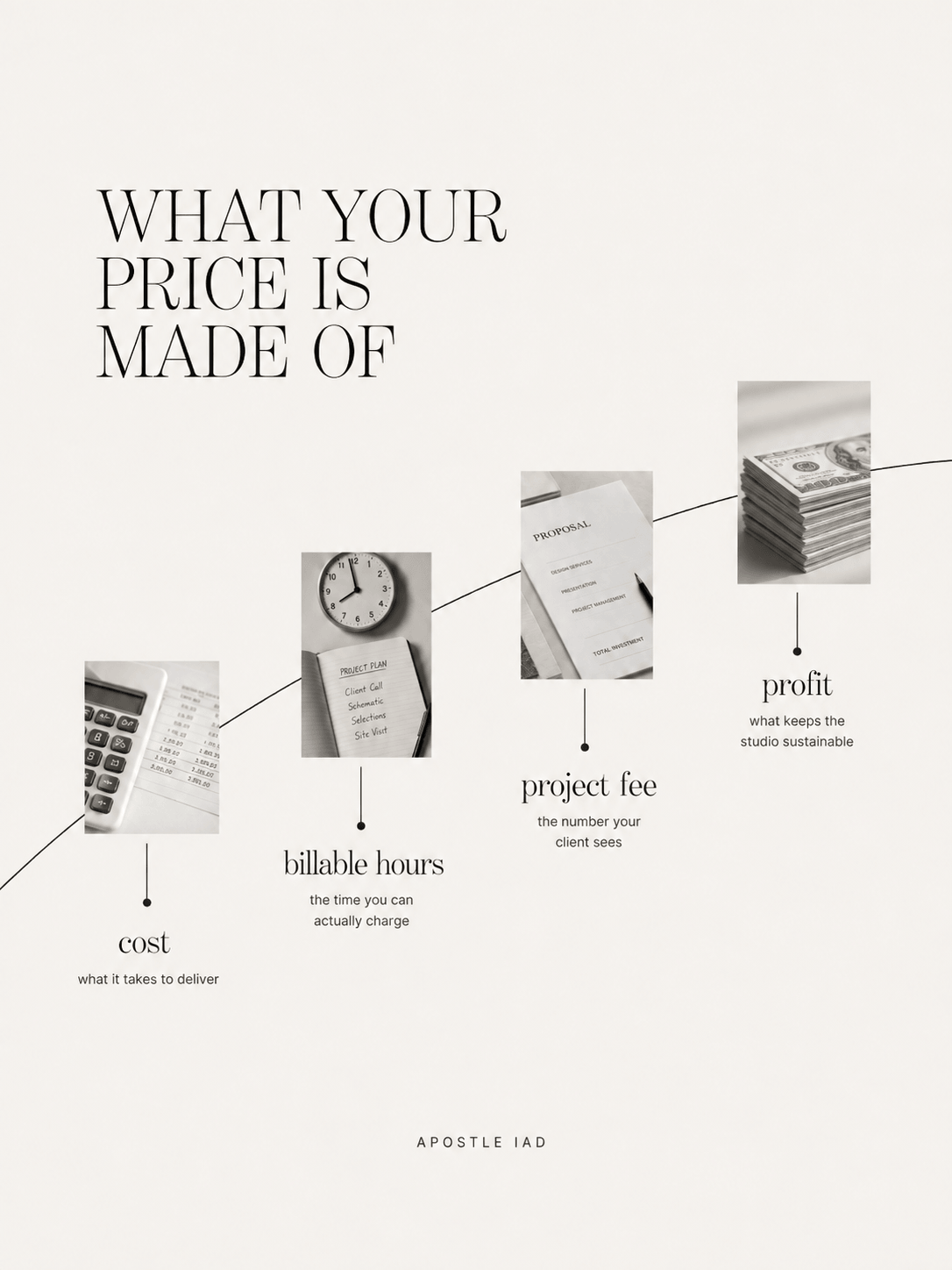
Clients are not purchasing units of your time. They are purchasing a defined result delivered through your judgment. That is why a project fee should respond to scope, complexity, decision load, coordination and risk.
Two 500-square-foot rooms can require radically different levels of work. One may be furnishings with a clean procurement path. The other may include custom millwork, lighting redesign, stone detailing, contractor coordination and three decision-makers. Square footage is the same. Labor is not.
TRACK ESTIMATE AGAINST ACTUAL
Pricing improves when memory stops being the measurement system. At the end of each phase, compare estimated hours with actual hours and compare projected project margin with actual margin.
The point is not to punish yourself for a bad estimate. The point is to build your own pricing data. After five projects, your studio should know more about the true cost of its work than any generic pricing article can tell you.
THE PRACTICE
For your next proposal, write down four numbers before you send it: estimated labor hours, internal hourly cost, proposed fee and target profit. Then check the project against those numbers at the end of every phase.
A rate is not a strategy. Measurement is.
Xo,


Is Your Studio Client-Ready?
Take this 2-minute quiz to find out. Get a FREE Member Journey Guide for Interior Designers.